 Official Bio:
THE ORCHESTRA BAOBAB STORY
Orchestra Baobab are one of Africa’s great iconic bands, creators of one of the world’s most sublime and truly distinctive pop sounds. Founded in 1970, Orchestra Baobab fused Afro-Cuban rhythm and Portuguese Creole melody with Congolese rumba, high life and a whole gamut of local styles – kickstarting a musical renaissance in their native Senegal, which turned the capital Dakar into one of the world’s most vibrant musical cities. They produced more hits in less than a decade than other bands in a lifetime. While Baobab found themselves sidelined by the revolution they helped create and disbanded in 1985, a huge groundswell of international interest led to their triumphant reformation in 2001. Orchestra Baobab are still very much in business today.
'When I arrived in Senegal in 1968, there was only Cuban music,' says Orchestra Baobab’s Togolese guitarist Barthélemy Attisso. 'Back home, we were listening to Nigerian high life and Congolese guitar music, but if you walked past a club in Dakar, you would swear there were Cubans playing inside. Yet they were all Senegalese!'
If you want to get to grips with the Orchestra Baobab story, you have to get under the skin of their home town Dakar. Westernmost city on the African continent, former capital of France’s vast West African empire, Dakar has earned a reputation as one of the world’s most dynamic musical capitals, home to superstars like Youssou N’Dour, Baaba Maal and Cheikh Lô who have given Senegal perhaps the highest musical profile of any country in Africa. Yet in 1970, when Orchestra Baobab were formed, Dakar was still, in many ways like a French city, a tropical Marseille of art deco apartment blocks, showpiece modernist architecture and pavement cafes. And musically, the city was a backwater.
Neighbouring Mali and Guinea had taken a socialist path, developing new pop identities, based on the rediscovery of traditional sounds, from the 1950s onwards. But Senegal had maintained strong links with France, and its nightclubs were still dominated by the afro-cuban sounds that had been a massive influence in Africa since the 1940s.
But just a short distance from the Plateau, the airy European district, lay the Medina, Dakar’s original native quarter – home to Senegal’s leading ensemble, the mighty Star Band. And beyond it stretched an ever-expanding sprawl of poverty-stricken, shanty-town suburbs known as the ‘quartiers populaires’.
Now 65, percussionist and singer Balla Sidibe is a dignified, avuncular figure with a rich, deep voice. While he wasn’t the original leader of Orchestra Baobab (there wasn’t one), he was there from the beginning – present through every twist and turn of the band’s chequered career – and he was the one who did most to keep the spirit of Orchestra Baobab alive during its darkest hours.
When our story starts, Sidibe was just one of a pool of semi-professional musicians who served Dakar’s nightclubs, moving from band to band in search of better pay and conditions, but rarely achieving more than a local profile. A former gendarme and sometime paratrooper, Sidibe had played in bands in his home town in the Casamance, Senegal’s southern region. Having come to Dakar with the intention of joining the elite presidential guard, he soon found himself embroiled in the music scene, alongside another young singer from the Casamance, a language student named Rudy Gomis.
‘We were young, and looking for excitement,’ says Sidibe. ‘We played in the Café Palladium every Monday once the resident orchestra stopped playing. But we weren’t aware that we were preparing our musical careers. We just played to have a few francs in our pockets. We weren’t married. We had no responsibilities. Life was beautiful.’
By 1970, Sidibe and Gomis had graduated through the Standard Orchestra to the country’s leading ensemble – the Star Band of the Miami Nightclub. Founded by the club’s owner, Ibra ‘Le Grand’ Kasse, to celebrate Senegalese independence in 1960, the Star Band had become a school through which every musician of any worth passed, and the crucibile for the gradual Africanisation of Senegalese music. Kasse encouraged the musicians to sing in their own languages, to play traditional songs and indigenous instruments such as the tama (or talking drum).
Sidibe transposed Cuban standards into the rolling cadences of his native Mandinka; Gomis specialised in lilting, melancholy ballads in Portuguese Creole. While Gomis soon tired of Kasse’s dictatorial ways and left, Sidibe stayed on.
‘Ibra Kasse was a perfectionist. We would arrive at 9pm, and he would give us the music we were to play at midnight. There was no discussion. If you sang out of tune he would simply cut you off. It sometimes made us very angry, but it allowed us to master certain things. Without him we could never have come so far.’
Situated in the proletarian Medina, the Miami was a typical African nightclub, lively, populist and slightly seedy. But up the road in the heart of the European quarter, a new club was opening with a very different feel, which was to have huge impact on Senegalese popular culture.
Created in 1970 by a group of young businessmen and politicians as an exclusive meeting place near the country’s National Assembly, the Baobab Club quickly established itself as Dakar’s chicest nightspot. Decorated by Senegal’s top artists, it had a bar in the form of the trunk of a baobab – the majestic tree of the savannah.
Veteran Star Band saxman Baro Ndiaye was brought in to provide the music, and he quickly poached his former band’s most promising younger members: Sidibe, Gomis, and a young Togolese law student named Barthélemy Attisso, who had taken up music to pay his course fees, but who was emerging as one of the city’s most talented guitarists.
‘The Baobab was beautiful,’ says Sidibe. ‘There was a strict dress code: a suit and tie or full traditional robes. You had to be somebody to even get in there. We musicians realised we had to bring the kind of quality that people expected in a place like that.‘
The fact that none of the three were Dakar insiders was highly significant in the evolution of the Baobab sound. Sidibe and Gomis’s husky voices worked superbly together, their deep-velvet harmonies redolent of the tropical atmosphere of their native Casamance. Attisso, meanwhile, was steeped in Ghanaian high life and Congolese music, and was evolving his own idiosyncratic version of the florid Congolese guitar style of Franco and Dr Nico, filtered through influences as diverse as Wes Montgomery, BB King and Carlos Santana.
In contrast to these warm, rich, lyrical flavours, Laye Mboup, another crucial early member, brought the starker, neo-Islamic sounds of the Dakar region. A griot – traditional praise singer – working with the National Instrumental Ensemble, he sang entirely in Wolof, the lingua franca of Dakar, which was becoming increasingly important as an indicator of national identity. Mboup’s use of the arcane language of the griots, combined with his personal charisma and sex appeal added greatly to Baobab’s cachet – particularly with women. His soaring voice was heard to compelling effect on the smouldering ‘Nijaay’ from their first LP, released on the club’s own label in 1972. He died tragically in a car accident in 1975.
As Dakar’s elite danced till dawn with their soignée girlfriends, packing the club out five nights a week, Orchestra Baobab became established as Senegal’s top group. And as older members Ndiaye and original bass player Sidath Ly left, the group’s classic line-up was gradually established. Rhythm guitarist Latfi Benjeloun was of Moroccan parentage, bassist Charlie Ndiaye was from the Casamance, while drummer and percussionist Mountaga Kouyate hailed from eastern Senegal.
Singer Ndiouga Dieng, in contrast, was very Dakar – another Wolof griot, brought in to replace Laye Mboup during his absences with the National Ensemble. He introduced Thione Seck, a teenager with a wonderfully luminous, yearning voice. Medoune Dialo, another mainstay of this period, had the rich, vibrato-laden tone of a Cuban rumbero, but with an unmistakably nasal Senegalese tinge. Even more crucial to Baobab’s sound and image were the smokily rhapsodic tone and wayward charisma of rangy tenor saxman, Issa Cissoko, whose family originally from Mali.
Yet while each member brought his individual style and charisma, it all blended into one unmistakable sound. Whatever the language or the rhythm, the most compelling feature of any Baobab song was the warm, lilting and fabulously melodic Baobab sound.
Baobab’s heyday at their eponymous home club lasted seven glorious years, during which they also toured in Cameroon, Tunisia and Guinea. The poor sales of a series of five LPs recorded in one marathon session & pressed by the club’s owners in America, led to bad feeling between band and employers. In 1977, Orchestra Baobab accepted an offer to move to the Jandeer nightclub at a vastly increased salary. But things didn’t work out as they’d hoped, and they moved to the Balafon – run by a Madame Michel – before decamping to Paris in 1978. Their six month stay produced two highly rated albums, recorded with up and coming producer Ibrahima Sylla, ‘Baobab à Paris, Vols 1 & 2’, which included the perennial favourite ‘On Verra Ca’. Yet it proved an unsatisfactory experience and they returned to Senegal out of pocket and without a club residency.
Baobab were soon ensconced at the Ngalam, and proved so successful that the club had to be rebuilt to accommodate the crowds they attracted. Much of the band’s best material dates from this period. Their 1981 album ‘Mohammadou Bamba’ features stunning vocal performances from Thione Seck on the title track and Ndiouga Dieng on ‘Bulmamin’. Yet all was not well with Orchestra Baobab. They couldn’t shake off the old nightclub ethos where musicians came and went as the mood took them, and the personnel was never entirely stable.
Baobab’s 1982 album ‘Ken Dou Werente’ included many of their most famous songs, ‘Coumba’, ‘Ledi Njemme Mbodj’ and ‘Utru Horas’ – Rudy Gomis’s magnificent, slowburning lament which predicted the civil war in his native Casamance. Yet while the album should have been their defining masterpiece, it went largely ignored.
Orchestra Baobab had barely noticed it, but the balance of Senegalese society was changing. Out in the quartiers populaires, the sprawling, impoverished suburbs, which had grown vastly in size over the decade of Baobab’s supremacy, a pop revolution was underway. And the focus for these new developments was the band’s old alma mater, the Star Band. While their old ensemble had been temporarily put out of business by the rise of Orchestra Baobab, it had revived with an influx of new talent, including an extraordinary young singer named Youssou N’Dour. In 1979 these young turks left to form Etoile de Dakar, a band whose arrival had on impact equivalent to that of punk in the West.
While the new generation drew on Baobab’s freewheeling, pan-African approach, they pushed one element right to the fore of their sound – the Wolof rhythms of Dakar. The hard-cracking sabar drums and the tama talking drum became the signature sounds of a new genre – mbalax. While mbalax rhythms had been present in Baobab’s music – mbalax was in fact what Laye Mboup had been doing with them ten years before – they had been subsumed into the gracious flow of the Baobab sound, played not on sabar drums, but on afro-cuban congas.
Charlie Ndiaye sums up the times: Sometimes I think the success of mbalax was perhaps linked to the phenomen of urbanisation. People left the villages and came to the capital and those people didn’t know how to dance salsa properly. Not even R&B. But the sabar was easy to dance for them. And it was a women’s thing. They loved it and with that, things were decided. Where women go, men will go too, especially in matters of dancing. Women went to dance the sabar at Youssou’s club and the men followed them.
Faced with dwindling audiences, Baobab had to decide whether to adapt musically to the new changes or simply call it a day. ‘We decided against following fashion,’ says Attisso. ‘That meant our gradual decline, but we accepted that in order to protect our originality, our identity.’
Thione Seck had already left to form his own highly successful mbalax outfit, Attisso got a job at the university and gradually the other members left, till there was only the original vocal duo Balla Sidibe and Rudy Gomis with bass player Charlie Ndiaye. An attempt to forge an updated version of the Baobab sound with a group of younger musicians failed to find an audience, and finally Sidibe was left as sole custodian of the name Orchestra Baobab.
Yet the late 1980s, when Orchestra Baobab were at the lowest point of their popularity in Senegal, was the very period when their music was being discovered on the burgeoning Western world music scene. While the likes of Youssou N’Dour and Baaba Maal were trying to break into the Western mainstream, Baobab’s earthily melodic sound struck a chord with listeners discovering African music for the first time. Baobab’s neglected 1982 album ‘Ken Dou Werente’ became a sought-after cult-classic. In 1989, it was re-released to huge acclaim by World Circuit under the title ‘Pirate’s Choice’.
Yet while Orchestra Baobab were now established among Western connoisseurs as icons of the African dance-band era, many of the original members were struggling. Sidibe, Ndiaye and Latfi Benjeloun eked out a precarious living playing in hotel foyers, while Gomis was running an African language school for foreign aid workers and Attisso had long since returned to his native Togo.
World Circuit's Nick Gold had long dreamed of reuniting Orchestra Baobab. Incidentally, the band's subtle blend of the African and latin was one of the main reasons behind the proposed meeting of Africans & Cubans convened by World Circuit in Havana in 1996 - a project which eventually became the multi million selling BVSC phenomenon. Talks about reforming the band had begun in 1997, by which time the cultural climate in Senegal had radically changed.
The novelty had long since gone out of mbalax, and a more open and pluralistic attitude prevailed. Indeed, among those closely involved in Baobab’s revival was Youssou N’Dour, who, it turned out, had been a huge Baobab fan all along. ‘They had such a clean sound,’ he says. ‘And they were pan-African. We’re ready for this approach to come back. We’ve put up too many barriers in our music. Young people understand now how important those years – the 1970s – were for our music. So they’re ready to listen.’
It was agreed that Baobab should appear at a special Dakar concert at London’s Barbican in May 2001 – on the proviso that guitarist Attisso would take part. Attisso was eventually tracked down to Togo, where he was running a successful commercial law practice, though he hadn’t touched a guitar in 15 years. Thierno Koite – sometime Youssou N’Dour sideman and brother of Baobab drummer Mountaga – was recruited on alto sax, while Assane Mboup, an up and coming star of Dakar’s mbalax scene, fulfilled the role played by his hero Laye Mboup.
The Barbican concert provoked ecstatic responses from the Western media. Far from crassly modernising their music, as many fans had feared, the group looked and sounded as though they had stepped through a 1970s time-warp. ‘Pirates Choice’ was re-released as a remastered double album with additional rare tracks, and a year of euphoric international touring followed. Finally, in June 2002, Orchestra Baobab made a triumphant return to Senegal to coincide with the release of a new album, ‘Specialist in All Styles’, their first in nearly twenty years. Comprising lovingly crafted reworkings of some of their best-loved songs, the album was co-produced by Youssou N’Dour and Nick Gold and featured cameos from N’Dour and the great Buena Vista crooner Ibrahim Ferrer.
Orchestra Baobab won two awards at the BBC Radio 3 Awards for World Music 2003 – in the Africa category and for Album of the Year – gained a Grammy nomination, were the subjects of VH1 Special and took part in the highly prestigious Nobel Peace Prize Concert in Oslo.
Following on from a series of international tours, the band recently took up a Dakar club residency for the first time in nearly twenty years, playing hugely popular Saturday night sessions at the Just 4 U club. Here they began developing material for ‘Made in Dakar’, an album that takes them back to their lo-fi roots in the clubs and streets of their home town. ‘Made in Dakar’ presents a string of beautifully crafted new songs alongside reworked gems from their 20 album discography, some of which date back to their apprentice days in the Star Band.
‘Made in Dakar’ squares the circle on a band who suffered a sixteen year career hiatus, but for whom the flame never quite went out. As guitarist Barthélemy Attisso puts it, ‘We were very anxious before the Barbican concert, but when we heard the strength of the applause, we heaved a sigh of relief. And that's how the adventure started again. We had just been on standby for a moment. The Baobab is a strong tree. Even if you cut it down, it will keep on growing. So when you speak of Orchestra Baobab, you know that we're not the kind of band to disappear quietly.’
Live On Stage:
These guys are legends in their native country, but really unknowns here until Dave Matthews and Trey Anastasio hooked up with them and brought their music to a wider audience with a VH1 special. Ok so they don't sing in English, but these guys are fantastic and should be on your radar when putting together your schedule. Here they are with "On Verra Ca"....
Stream a full concert they did for NPR from back in 2005.
No official music videos from these guys, so let's go with another live performance, from the Malta Jazz Fest...
I can also highly recommend their album Specialists In All Styles, it's a great starting point if you're looking to get into their music.
For more on Orchestera Baobab head on over to their official MySpace page.
Friday, March 7, 2008
Bonnawho's Who - Orchestra Baobab

Thursday, March 6, 2008
Bonnawho's Who - Nicole Atkins
 Official Bio:
The shores of New Jersey are littered, quite literally, with small towns whose better days are far in the past. They’re towns that have been written about, and sung over; towns that have been mythologized and idealized; and they are the towns that 28-year-old musician Nicole Atkins—a native of Neptune City, located a stones throw from fabled Asbury Park—was born and raised in.
They can be places steeped in their own history, buried under the sense of their own pasts. Places of hey-days and what-once-was. And it’s that sense of something lost, and of what perhaps should have been, and what might be, that permeates Atkins’s debut, Neptune City.
“Neptune City is just this old place,” Nicole says. “There was this glory time, way back when, that I never experienced, but that you cannot escape if you live there. Everyone talks about. They almost yearn for it, but I never experienced it. So maybe this album is my attempt to build something new on top of all that.”
It’s these environs that brought her to where she is today. Nicole was that kid slightly out of touch. When her friends were collecting the latest New Kids on the Block album, she was raving about Traffic or Cream. At the age of 13 she found an old beat up guitar in the attic of her house. It had belonged to an uncle who died when he was young, and she taught herself to play a Grateful Dead song. Her father turned her on to blues artists like Jimmy Reed, and allowed Nicole to sit in on sessions with local musician friends. And then she left that town, that place, behind, attending art school in North Carolina, where she played for three years with the North Carolina alt-country band Los Parasols before making a name for herself as a solo performer on New York City’s anti-folk scene. She slept in an old Dodge Ram Charger on Avenue A, finally, with a little help from her friends, among them David Muller (occasionally a member of Yoko Ono’s band, Fiery Furnaces and Fischer Spooner) finally discovered her own sound.
And it’s that sound that washes over Neptune City, produced by Tore Johansson (Cardigans, Franz Ferdinand, OK Go, Saint Etienne, New Order), an album that sounds like it came from anywhere but the New Jersey Americana rock tradition made famous by Bruce Springsteen. Her music ranges far afield: at some times vaudevillian, at others psychedelic, a little bit country, a dash from early musicals, all under a cloud of pop-noir, often all coming in the very same song. Atkins writes songs that could have come from an episode of Six Feet Under, or an updating of Grease, as directed by David Lynch.
The characters in her tunes seem to live in an idealized past. “This record is the history of my town; it’s the history of my family and friend in this town,” she explains. “From the time I was a kid I started collecting these sad little tragically beautiful personal stories from the people in my life, and my own as well. That sense of history really appeals to me as an artist.” These tales became her blue prints, her inspiration, that would become songs like “Maybe Tonight,” a Ronnettes sounding traipse about a possible chance meeting, or “The Way It Is,” a dark and haunting defense, an insistence by someone hell bent on finding out for herself that something might be wrong. But it might be right, too.
The record calls to mind Roy Orbison if he were a woman; the bleak visions of Nick Cave and Leonard Cohen; the darkly mysterious girl group-on-acid musings of Julee Cruise and Lynch composer Angelo Badalamenti; the sorrow of Patsy Cline, the ‘60s experimentation of Love and Nuggets; all with a redeeming sense of hope amidst the emotional wreckage that is all Nicole. A sense that’s perfectly captured on “Cool Enough,” on which she sings, “I don’t care where you’re going/You’re taking me with you/This place got nothing that I could want/But I think that someday, I might feel different/But still, that’s someday/Still that’s someday/So take me with you.”
“War Torn” is about the frustration of a long-distance relationship that inevitably must end for your own good, while “Neptune City,” with its double-tracked harmonies providing its ghostly atmosphere, is an elegy, an homage, to her home.
Over everything, Atkins brings a painterly quality to her music, fitting for a woman who studied illustration while at UNC Charlotte, and still has her own mural business. Her songs are aural paintings, mixing and matching colors and sounds.
“That’s why I have such a hard time playing solo these days,” says Nicole, who plied her trade in hundreds of bars North Carolina, New York, and New Jersey before attracting the attention of a major entertainment attorney, who helped her get signed. “When I write a song, I think about all the different layers that will go on top of it.”
In the end, Neptune City comes across as a restoration project in a way, an attempt to build something new on something old. There’s an acute subtlety to the art of restoration. Do it wrong and you’re simply cribbing the past. Do it right and you’re actually, in a profound way, carrying it forward into today. And that’s what Neptune City accomplishes. It brings its past with it, carries its heart on its sleeve, and strides hopefully into a better day it can hardly imagine, but hopes will be there nonetheless.
Live On Stage:
Man I'm getting stumped on some of these acts at the bottom of the bill this year. I really don't know anything about Nicole Atkins at all, so let's discover her together. Here's her performance on The Late Show from last October...
Pretty damn good. Sort of sexy, jazzy, Broadway-esque.
Nicole Atkins On The World Cafe
Music Videos:
Nicole's got two music videos, both off of her debut album Neptune City. Here's the title track from the album...
And here's "The Way It Is"...
For more on Nicole Atkins head on over to here official site.
Sunday, March 2, 2008
Bonnawho's Who - Chromeo
 Official Bio:
Chromeo is Pee Thug and Dave 1: best friends since their adolescence, virtuoso musicians, walking hip hop encyclopedias, and the only successful Arab/Jew partnership since the dawn of human culture. After spending the three years since the release of their debut album, She’s In Control, jet setting, globetrotting, and embarking on an overall sensual conquest of planet Earth, Chromeo headed back to their Montreal lab to put together album number deux.
The result, Fancy Footwork, is quite simply the most smoothed-out, hook-heavy, unabashed lovers’ funk since…Chromeo’s last album, actually. What makes this footwork so fancy, you ask? Step the fuck off and open your heart to the finest distillation of Minneapolis groove this side of Mazarati. Dave and Pee are back in the ‘07 to heal the fractured soul of dance music. Teenage lovers, 20 something blogpoders, 30 something burn-out ex-raver “graphic designers” and 40 something sistas can all finally party under one roof...and that roof has a name, AND that roof is on fire, and the only ones who can put out that funk-fire also happen to be the guys the roof is named after: CHROMEO.
Does analog synth wizard P-Thugg still rock nightgown-sized DipSet t shirts, talk through a keyboard, and have the thousand-yard stare of a well-practiced gangster? You bet he fucking does. Does vocalist and guitarist Dave 1 still dress like a French Lit professor from 1965? Can he still ask you to twerk without coming off like an imposter? You better believe he can. Chromeo is slick. Chromeo is dripping with reverb. Chromeo is Moog riffs, luxurious harmonies, macho guitar solos and real-deal songcraft. From the dancefloor-ready singles “Fancy Footwork” and “Tenderoni,” to the autobiographical Jew-boy ballad “Momma's Boy,” to the epic sax-laden album closer “100%,” Fancy Footwork rolls you through a sleek, melodic world where all you need to worry about is whether you’ve got your sunglasses on and the right moves to keep up. Remember the debate when Chromeo first came on the scene? The endless back and forth about whether those boys were joking or not? Well, Fancy Footwork will put any vestigial haters to sleep forever. There ain’t nothing “ironical” about this music. It’s Hall & Oates riding on 22’s, busting shots in the air with Quincy Jones driving. That shit ain’t funny.
So there you have it: Chromeo, the band reborn...the sex, the beats, the dream, the suits, the gloves, the laughs, the tears, the past and the future. All rolled up into one big blunt, smoked up through Pee’s talkbox tube and exhaled into your brain. Enjoy.
Live On Stage:
If you like to get your dance on, then you're going to love yourself some Chromeo. Their sounds falls somewhere in the realm of disco, electro-funk - lots of synthy sounds, with a catchy dance beat. Here they are with "Bonafied Lovin'" from their appearance on Jimmy Kimmel...
I don't think it would be far off to compare these guys to Gnarls Barkley.
Music Videos:
From the looks of it the guys in Chromeo like to have fun with music videos, here's "Needy Girl"...
Let's go with a two-fer since I'm digging their videos, here's "Tenderoni"
Couple more for you to check out...
Fancy Footwork
You're So Gangsta
Rage
Here's an IMEEM chocked full of Chromeo...
For more on Chromeo head on over to their official website.
Saturday, March 1, 2008
Bonnawho's Who - Against Me!
 Official Bio:
A decade ago, Tom Gabel began his music career as a 17-year old solo acoustic act known as Against Me!, belting out songs of rebellion in laundromats and any other venue that would have him.
Flash forward to today, and Gabel’s agitation cycle is still cranked high, but not without a wild streak of optimism thrown in for good measure. For the past five years, the gravelly roar of the vocalist/guitar player has been part of a thunderous and thoughtful foursome featuring Andrew Seward (bass), Warren Oakes (drums) and James Bowman (guitar), still doing business under the Against Me! moniker. Churning out a distinctive blend of punk, rock, and even folk that is impossible to label, they have toured all 50 states and foreign lands from Iceland to Australia, forging an intense connection with their growing legions of fans.
Now, after three successful full-length records on indie labels-- Reinventing Axl Rose (No Idea, 2002); As The Eternal Cowboy (Fat Wreck Chords, 2003) and Searching For A Former Clarity (Fat Wreck Chords 2005), which reached #9 on the Billboard Top Independent Albums chart and featured the thumping “Don’t Lose Touch”-- this Gainesville, Florida band is making its major-label debut on July 10, 2007 with New Wave (Sire Records). The title is tidal for a powerful reason.
“We felt like that was our mission statement, or our manifesto for the record,” Gabel said. “Instead of sitting back and complaining about how there's no good music out there, you should be energized and take things over. Be the bands you want to hear. It meant 'wave' in a literal sense, coming and washing away mediocrity… Why let someone else have the loudest voice?” asks Gabel, and with his band’s new record, he most surely has not.
The album opens with a colossal, angst-fueled one-two punch: “New Wave” and “Up The Cuts” are driving, irresistible tracks, seething with energy and alternately pleading and snarling for change. It’s a theme that reverberates throughout the record, both on personal and artistic levels, coming up again most pointedly in “Piss And Vinegar,” with Gabel caterwauling “Just say what you’re thinking!” to the faceless pap-pushers of the mainstream.
For a D.I.Y. outfit like Against Me!, signing to a major label meant some changes in approach—namely, that the band was going to enlist a full-time producer for the first time. They didn’t mess around, teaming up with alt-rock heavyweight Butch Vig (Nirvana, Smashing Pumpkins, Sonic Youth, Garbage).
When the label was prepping a list of potential producers, Gabel and his mates were afraid the candidates would be hot-shots who “didn’t even give a f*ck about our band,” the singer says with a laugh. He confirms that a few mega-producers were indeed on the document, “but Butch was there, and I’ve been a fan of tons of his records, all across the board. I like the fact that the majority of his records are great-sounding sonically, but still sound like real bands. They don’t sound like all the life has been drained out of them.”
For his part, Vig was instantly drawn to the relative unknowns the first time he saw the band play live. “I was blown away by the way they played the intensity and the reaction from the crowd,” Vig said. “The way the audience sings all the songs, I could see this passionate connection with their fans and the way the band communicates with them.”
The veteran producer was excited to work with a band that’s not shy about sharing their feeling on any subject. “One of things I found refreshing in their music, in Tom’s lyrics, is that they give a shit, but they’re never preachy or anything,” Vig shares. “He’s saying something that makes you think about what’s going on. The songs lyrically are complicated and dense. They’re not simple pop songs, but they rock.”
The first single, “Thrash Unreal (Bah Bah),” is a perfect example. In the manner of early Tom Waits and Bruce Springsteen songs, it empathetically chronicles the damaged life of a typical college-town burnout—a 40-something female junkie who says she has no regrets—to a defiantly upbeat chorus.
Bass player Seward, who joined Against Me! in 2002, says the new step forward for the band is “not a new adventure—it’s an extension of the adventure. It’s something we wanted to do—we own this move [to a major label]. But I’m not going to lie to you,” Seward added. “I was scared shitless, like ‘Oh shit we’re going to make a complete rookie mistake, we’re going to go to Hollywood to some big-time studio and record something that sounds like…” he trails off with a laugh. Instead, Seward is proud of their latest work, saying “Tom has written by far the best batch of songs he’s ever crafted… Everything is necessary in these songs, everything is there for the greater good. There’s no bullshit or filler in there.”
To make sure he had absolute focus on writing the record, Gabel holed up in a Gainesville motel whenever the band wasn’t touring. As with previous Against Me! records, the subject matter on New Wave is freewheeling, as befits the mind of a 27-year old American male at a crossroads in his life. Conceived by Gabel as “in many ways, a reaction” to the “self-centered, dark and moody” terrain of Searching For A Former Clarity, the new 10-track, 34-minute CD covers the topics of love, lust, war, personal integrity and substance abuse, with a unique blend of attitude that Vig describes as “intense, but with a positive undercurrent.”
New fans drawn by the incendiary 2006 “Jimmy Kimmel Live” performance of Former Clarity’s sizzling screed “From Her Lips To God’s Ears (The Energizer),” with its plaintive chorus of “Condoleeza! What are we gonna do now?” will find more in store. The former “Army brat” (until his parents divorced when he was 12) has stepped up to the plate and cranked out two more raucous fist-pumpers about war and national identity.
“White People For Peace” celebrates the nobility/futility of protesting war, while “Americans Abroad” rails against corporate greed with the aid of Oakes’ road-rage drums and Bowman’s ominous guitar tremolos, before boomeranging with a cautionary that maybe we’re all part of the problem—even the band.
“I don’t feel like I’m a person who has any answers,” says Gabel, who self-published a ‘zine called Misanthrope while in his teens. “But I often feel like I’m searching for identity in the world and trying to figure out where I fit in.”
Wide-eyed and world-weary. Never naïve, but often idealistic, Against Me! is in many ways the punk-rock embodiment of Matthew Modine’s character, “Private Joker,” in the classic Stanley Kubrick film Full Metal Jacket. They’re flashing peace signs in a seething mosh pit, and there’s no place else they’d rather be.
Live On Stage:
I don't want to make any blanket generalizations about Against Me! - they seem just like a straight ahead mainstream rock band from what I can tell, usually the kind of stuff I avoid. They are currently on the road opening for the Foo Fighters and later in the summer can be seen on the Warped Tour. Let's take a look at them from last year's SXSW with "New Wave"...
Spin named their latest album New Wave their album of the year for '07, while Rolling Stone had it at #9. I can't really vouch for this download, but did find this...
Against Me! - Live In London
Also Ben Lee loved the album so much that he recorded his own version of it.
Music Videos:
Let's go with "Thrash Unreal" the second single ofF their latest...
Here's a few more to check out...
White People For Peace
Don't Lost Touch
Turn Those Clapping Hands Into Angry Ballled
Want more, here's a rather lengthy and assuming full discography in a nifty IMEEM playlist...
For more on Againt Me! hit up their official website.
Bonnawho's Who - MGMT
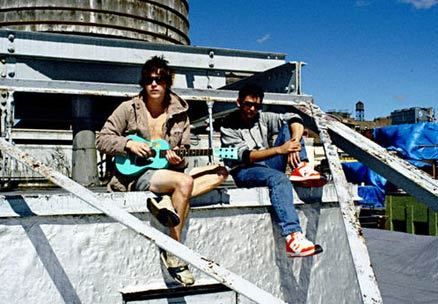 Official Bio:
40 years after the Summer of Love (and 30 years after the Summer of Hate), MGMT is celebrating the grand re-opening of the third eye of the world with Oracular Spectacular, the duo's much-anticipated first full-length album, an enigmatic and prophetic collection of hallucinatory sounds and hook-riddled pop tones for the new millennium.
MGMT is: Andrew Vanwyngarden and Ben Goldwasser, two psychic pilgrims whose paths first intersected in the green pastures of Wesleyan University in Middletown, Connecticut, circa 2002. "We weren't trying to start a band," Ben remembers. "We were just hanging out, showing each other music that we liked."
Andrew and Ben realized that -- despite their opposing views on methodology (one is spontaneously practical, the other is practically spontaneous) -- they shared a common love of mystic paganism (ironic indeed on a campus named for the founder of Methodism), psychotropic sounds, and the belief that a joke (or a joke song) could be sad, profound, and funny at the same time.
The pair was drawn to the music of other duos and found themselves incorporating the implications of the hallucinatory power-twee of the Incredible String Band, the roaring subway minimalist electronica of Suicide, the silky pop-soul of Hall & Oates, the pulsing narcotic trance of Spacemen 3, the avant-garde industrial romanticism of Royal Trux and much more into the constantly evolving sounds of MGMT.
As on-campus performance art provocateurs, Andrew and Ben began staging a series of "these obnoxious, noisy live electronic shows -- we never planned on having it be a recorded project -- where we would write these weird techno loops and arrangements that we could play with live. Most of it was running live off the computer and we had a turntable plugged into some guitar pedals, a radio, and a tape player. It was all electronically generated at that point. We would write a new song for each show and our shows would be 15 minutes long."
The One Song/One Show ethos is manifest in the tracks of Oracular Spectacular, each song on the album shimmers with its own diamond-hard compression of elements interconnecting within MGMT's "unusual or unconventional pop structures." Continually inverting expectations, the music of MGMT owes as much to chaos theory as it does to fractal geometry. In contrast to the group's early live shows, which were mainly electronically generated, Oracular Spectacular is filled with "more traditional rock instruments: electric guitar, bass, drums, keyboards, synthesizers all played live."
Restlessly experimental and consumed with divine discontent, the members of MGMT embarked on a series of temporary guises. "We went on a tour with a drummer once," Andrew confesses, "after we'd written these weird California Creedence Clearwater-style songs in two weeks. We went out, played them, and never did the songs again. A lot of people hated it. That used to be the goal of our shows. We were still trying to be obnoxious and somehow people got into it. Some songs we wrote just because we wanted to learn how to be really bad within a certain genre and then people started liking the song because they liked the genre. It was an accident that people started liking us."
Some of those first fans included a group of NYU students who formed an indie label, Cantora Records, in order to issue the very first MGMT commercial release, Time To Pretend (a 6-song EP, currently available on iTunes). Two of the songs from that EP -- "Time To Pretend" (the MGMT "mission statement") and "Kids" ("filled with all those college feelings: naivety, idealism, nostalgia, happiness, sadness") -- have made it on to Oracular Spectacular.
Following the release of the EP and a couple of one-month long tours, MGMT took six months off, with Andrew moving to Brooklyn for a post-college "existential crisis" and Ben hanging out in Connecticut before heading to upstate New York to work woodland construction.
Following their hiatus from MGMT, Ben and Andrew reconnoitered in Brooklyn and began recording new songs for the sheer fun of it on an "Mbox computer set-up." Those humble home sessions -- at once Apollonian and Dionysian -- lay the groundwork for what would become Oracular Spectacular.
Oracular Spectacular opens with "Time To Pretend" ("fanciful but with an undercurrent of impending doom") and closes with "Future Reflections" ("premonitions of a post-apocalyptic future where colonies of young people live on the beach and lead savage yet refined primitive lifestyles and go surfing"). In between lie the refractions of the "current chaotic vibrations of the world" on a album which distills the essence of the past, promises and portends the future, and offers an absorbing transformative experience between the molecules in the pulsations of the present. Not to mention an authentic "4th Dimensional Transition."
"Kids are going to be inheriting their parents MP3 collections," Ben predicts. "And, in that aesthetic, corrupted MP3 files will be like the way people glorify scratched-up records now. In 20 years, people will listen to these 30th generation MP3s and say, 'I love that sound!'"
MGMT invites you to open your mind to the multi-dimensional vibrating Technicolor sounds of Oracular Spectacular.
Live On Stage:
I've certainly seen the name MGMT around a lot over the last six months, but now after reading that bio I think I'm going to need to go and track some of their music down. Here they are making their network television debut on the Late Show - dressing up for the occasion with some nifty capes....
Definitely liked what I'm hearing, sort of dreamy, psychedelic indie-pop. No live shows floating around, so let's go with this performance of "Pieces Of What" from Later With Jules Holland...
Music Videos:
The band only has one official video (which I'll link to below), but even cooler is the interactive music video that they've created for "Electric Feel" - here's the demo...
Make your very own by downloading the program.
One more for you to check out...
Time To Pretend
I'm feeling ambitious today, so here's some more MGMT for you're listening pleasure...
For more on MGMT head to their official website.
Let's Get Started
Ok we're officially 103 days away, and figured I'd motivate and start getting some posts up here again and giving you the goods on just who's playing at this year's fest. So here's a sample of how things worked last year. I may add some IMEEM links too, but for the most part I'll keep it simple - Artist Bios, Live Performance, Downloads, Music Videos.
If you have any suggestions of other things that might be helpful email me or leave it in the comments section.
Let's get started....
Thursday, February 7, 2008
Mixology
I do this over on my other blog, so thought I'd bring it over here too. Here's a mix of some of the artists playing Manchester for the first time....
